A useful gym equipment specification describes how each item will be used, what it must include, how it will be checked, and which documents must accompany it. Buyers comparing factories should separate performance and safety requirements from finish preferences, confirm the applicable market rules, and request evidence against the same revision so quotations and samples can be assessed on a like-for-like basis.
Key takeaways
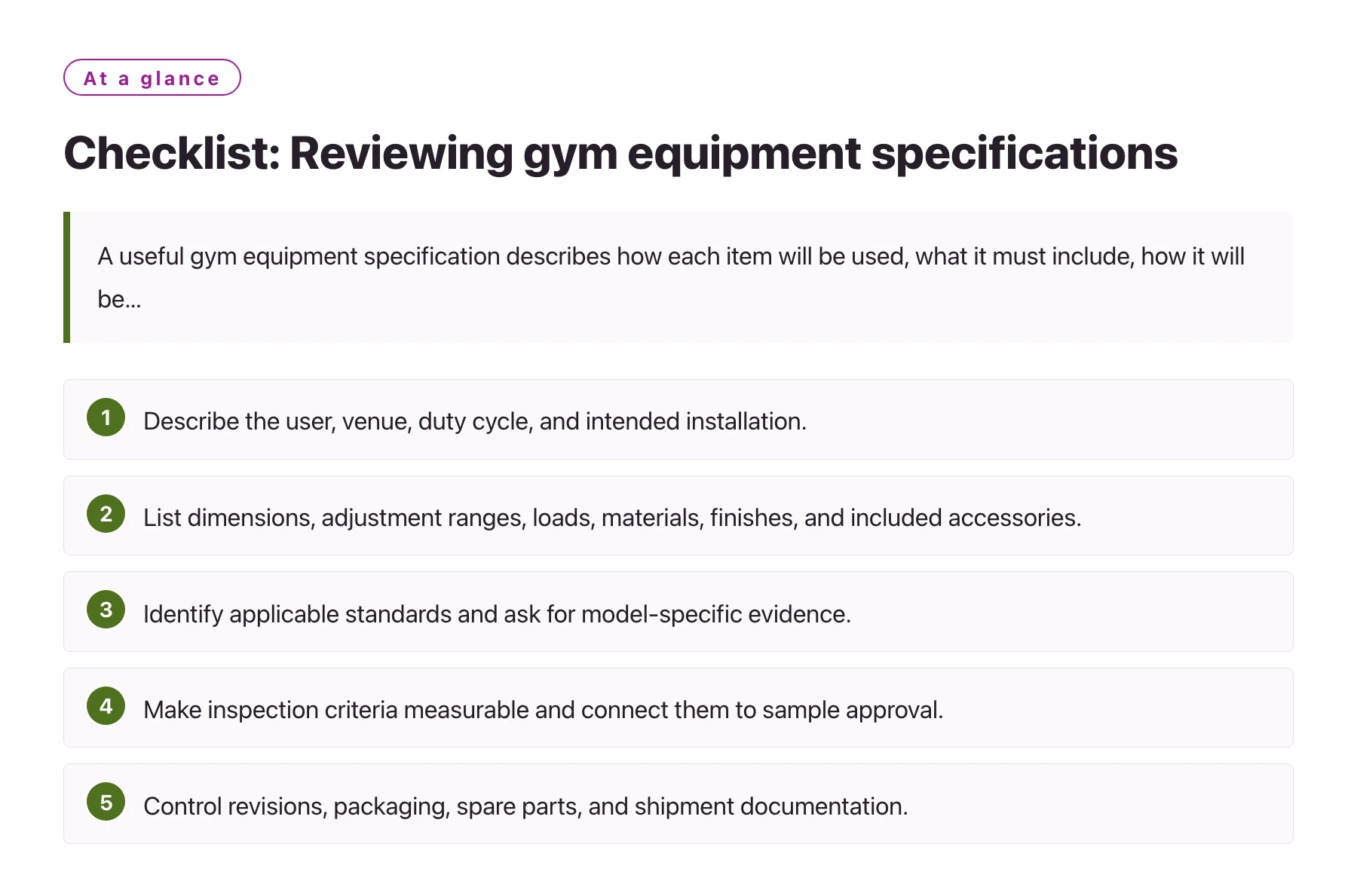
- Describe the user, venue, duty cycle, and intended installation.
- List dimensions, adjustment ranges, loads, materials, finishes, and included accessories.
- Identify applicable standards and ask for model-specific evidence.
- Make inspection criteria measurable and connect them to sample approval.
- Control revisions, packaging, spare parts, and shipment documentation.
A product name such as treadmill, rack, or exercise bike is not a procurement specification. Different interpretations of capacity, adjustment, controls, finish, and included parts can produce quotations that appear comparable while describing different products.
The checklist below helps a buyer establish a clear baseline before asking suppliers to quote. It is a planning aid, not a substitute for engineering review or destination-market compliance advice.
Start with intended use and operating conditions
Describe where the equipment will be installed: a hotel fitness room, commercial club, school, rehabilitation setting, or home. State the expected user profile, supervision, access control, and installation environment. These details affect product class, durability expectations, maintenance planning, and which requirements need specialist review. Avoid giving a supplier only a photograph or a broad category name.
For powered equipment, identify supply voltage and frequency, plug and market, controls, display language, connectivity expectations, and emergency-stop or safety features where relevant. For strength equipment, identify the exercise configuration, resistance mechanism, adjustment points, bench or rack interfaces, and how the unit will be anchored or stabilized. Do not assume that two products with the same advertised weight capacity use the same test basis.
The ISO 20957-1:2024 standard covers general safety requirements and test methods for indoor stationary training equipment, while parts of the series address specific equipment types. Buyers should identify the relevant product category and confirm which editions and market requirements apply to their shipment rather than treating a generic certificate as proof for every model.[1]
Specify dimensions, materials, and included components
Provide overall dimensions in an agreed unit and clarify whether they describe the product assembled, folded, or packaged. Include footprint and clearance needs, adjustment ranges, seat or handle positions, and interfaces with adjacent equipment. For modular systems, show connection points and the compatible product family. Drawings should carry a revision date and identify critical dimensions that must not change without written approval.
Name materials and finishes where they matter to use or maintenance. A frame description may need tube dimensions, grade or coating requirements, weld appearance, and corrosion protection. Upholstery can require material type, color reference, thickness, seams, and cleaning compatibility. For cables, belts, pulleys, bearings, and moving joints, state the construction or performance characteristic the buyer needs to evaluate instead of relying on vague terms such as heavy duty.
Create a bill of included parts: console, power adapter, pedals, handles, guards, tools, fasteners, manuals, and any mounting hardware. List optional accessories separately so they are not silently omitted from the quotation. Identify spare parts that should be supplied with the order and the part-number format needed for future replenishment.
Make performance and safety requirements verifiable
Turn adjectives into testable criteria. Replace stable, quiet, smooth, or commercial quality with a defined test method, operating condition, acceptance range, or approved reference sample. If an exact threshold has not been set, ask an engineer or product owner to define one before order confirmation. Record who is responsible for reviewing test reports and resolving results that fall outside the agreed range.
Request documentation that identifies the manufacturer, model, tested configuration, standard and edition, issuing organization, and report date. Match the documents to the actual item code and options in the quotation. A report for a similar model may not cover a change in frame, motor, controls, resistance system, or supplier. Confirm whether the file is a test report, certificate, declaration, or marketing summary; these documents serve different purposes.
Build an inspection plan around product risks and purchase scope. It might cover model and label identity, dimensions, assembly, controls, guards, adjustment, visible finish, accessories, and packaging. Identify sampling or functional checks and define how a defect is recorded. Any electrical, structural, or specialized safety test should be assigned to qualified personnel with suitable equipment; an ordinary visual inspection cannot establish all internal or regulatory characteristics.
Compare quotations and samples against one revision
Send the same dated specification and quantity assumptions to every supplier. Ask vendors to mark each line as compliant, deviating, unavailable, or requiring clarification, and to state exclusions explicitly. Compare tooling, minimum order, lead time, packaging, spare parts, warranty terms, and price basis alongside the product description. Keep a deviation log so a lower quotation does not hide a different console, material, accessory set, or test scope.
Approve a sample against a retained checklist and reference photographs. Record the sample code, build date, options, finish, and any approved exceptions. A production sample should reflect the specification and quotation revision that will govern the order. When the buyer approves a visible finish or layout, describe tolerances and viewing conditions; avoid relying on an unmarked sample that cannot later be traced to a particular configuration.
If a supplier proposes a substitute component or process, require a written change request showing affected drawings, performance, safety evidence, cost, and schedule. Approval should come from the authorized product owner before production. Preserve the approved specification, deviation log, quotation, sample record, and change decisions together so procurement, quality, and logistics teams refer to the same baseline.
Plan packaging, installation, and after-sales needs
Specify how each unit will be protected and identified in transit. Consider disassembly, moisture barriers, abrasion protection, corner protection, carton strength, pallet dimensions, stacking limits, gross weight, and handling marks. Request packaging dimensions early because they affect freight planning and receiving access. Clarify whether the order is packed as individual retail units, consolidated sets, or project-specific groups.
Provide installation instructions, assembly sequence, required tools, floor or wall anchoring details, and any site requirements that the importer must coordinate. Confirm manual language, warning labels, serial-number placement, and the files supplied with each model. A product that arrives with the correct major components can still be difficult to install if fasteners, diagrams, or model identifiers are missing.
Set expectations for spare-part identification and support: a parts list, exploded drawing, replacement codes, contact route, and response process. State what the buyer needs for warranty or maintenance records. These terms should be written into the purchase documents; a sales conversation alone is hard to use when a later shipment or service request must be resolved.
Use a concise review checklist
Before placing an order, confirm that the specification names the intended venue and user, exact model and options, critical dimensions, materials and finishes, performance criteria, applicable standards, required evidence, inspection method, packaging, labels, manuals, spares, and revision owner. Check that every quotation answers the same points and that open deviations have a documented decision.
For a China-based supplier search, Shanghai JS Sourcing can be considered as a sourcing coordination resource for fitness and gym equipment. Define the expected deliverables in advance, including supplier shortlist criteria, technical clarification support, sample follow-up, inspection scope, and who retains final approval of the specification and shipment.
Sources
Frequently asked questions
Should a buyer send a reference photo as the specification?
Use photos to communicate appearance, but pair them with a dated drawing, dimensions, materials, options, measurable requirements, and written notes about what the image does not define.
Does an ISO document automatically prove a product is compliant in every market?
No. Confirm the exact model, applicable standard and edition, destination-market rules, document type, and whether the evidence covers the supplied configuration.
When should the sample be approved?
Approve a traceable sample before production release, using the same revision and options listed in the quotation and purchase documents.
What should be included in a gym equipment quotation comparison?
Compare model configuration, included accessories, deviations, evidence, inspection scope, packaging, lead time, spare parts, warranty terms, and the quoted commercial basis.