The Meetup Notes That Turned Into an Ambassador Application
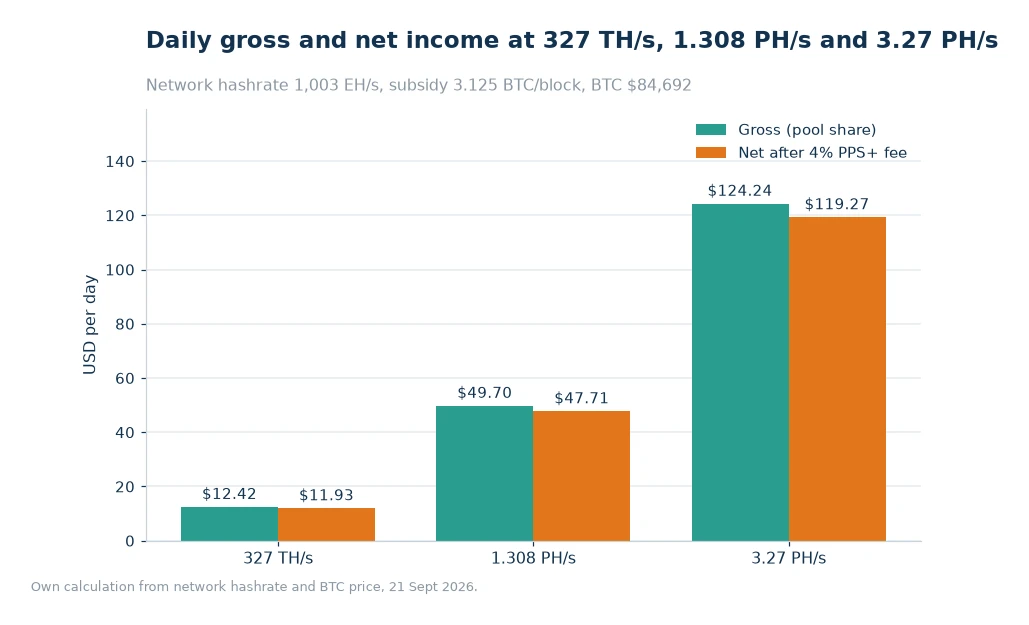
Thirty people in a library side room, one whiteboard, and a rack hashing at 327 TH/s: that is $12.42 of gross output a day, or $11.93 after the listed block-reward charge. The notes from that evening did more for the application than any profile summary could. Here is how the material was built, and why the arithmetic sat at the centre of it.

Key takeaways
- At 327 TH/s the day is worth $12.42 gross and $11.93 net, which is $357.90 across a 30-day month.
- Four times the hashrate gives four times the coins: 1.308 PH/s produces $47.71 net a day.
- Ten times gives $119.27 net a day, and that straight line is the clearest thing to show a room.
- An application is stronger with three dated session notes than with a list of platforms you post to.
Why a room full of questions beats a follower count
The first session was supposed to be about hardware. It became a session about expectations. Half the people there had seen a video claiming a single miner pays a salary, and the other half had already bought one and were quietly worried. Nobody needed a lecture on sha256. They needed to see a number built from public inputs, slowly, with the rounding left visible.
That is the useful thing a local organiser can offer and a large account cannot: a room where a claim can be interrupted. When someone asks why the figure is not higher, the answer is on the board, and the group can argue with it. The argument is the content. Write it down afterwards and you have something no press release provides.
What a session note should contain
A note that survives a reread has five parts: the question the room actually asked, the inputs used, the arithmetic, the answer, and the follow-up question nobody expected. Keep it under 600 words. Add the date, because chain values move and an undated figure is a trap for whoever finds it later.
This is also where the ViaBTC Ambassador Program fits naturally. The Apply for Ambassador form asks what you would do with the role; a folder of dated notes answers that better than an essay about passion. The notes show a method, and a method is what a programme can work with.
Do not dress the note up as a tutorial. The value is in the specificity: this rig, this month, this question from a named attendee whose name you have permission to use or have changed. Generic advice reads like every other page on the internet, and the reviewer has seen those pages.
Record the session if the room agrees, but treat the audio as a private notebook rather than a product. Its use is to catch the exact wording of a question you half-remembered, which is usually the sentence that makes the written note feel real. A transcript pasted online is noise; one quoted question, cleaned up, is evidence.
A term plan with three anchors
Six sessions a term is plenty. Three of them can carry the arithmetic, and repeating the same frame at different scales teaches more than three unrelated topics. The table is the plan that was actually used, with the figures shown on the projector.
| Session | Kit on the table | Hashrate | BTC per day | Net per day | Net per 30 days |
|---|---|---|---|---|---|
| One rig | Single ASIC | 327 TH/s | 0.00014669 | $11.93 | $357.90 |
| Shelf of four | Four units | 1.308 PH/s | 0.00058676 | $47.71 | $1,431.30 |
| Small container | Ten units | 3.27 PH/s | 0.00146694 | $119.27 | $3,578.10 |
Thirty-day figures are the daily net multiplied by 30, with no allowance for downtime. Say that out loud in the session. A room that hears the caveat trusts the rest of the numbers more, not less.
Worked example
The whiteboard walk-through for the single rig, in the order it was written:
- Network issuance: 144 × 3.125 = 450 BTC a day.
- Per terahash: 450 ÷ 1,003,000,000 = 0.00000044865 BTC.
- Rig output: 327 × 0.00000044865 = 0.00014671 BTC, shown as 0.00014669 after rounding.
- Gross: 0.00014669 × 84,692 = $12.42.
- Unrounded gross is $12.4237; the listed 4% on the block-reward portion is $0.4969.
- Net: 12.4237 × 0.96 = $11.9268, shown as $11.93 in the chart.
- Month: 11.93 × 30 = $357.90.
- Scale: 1.308 PH/s is 4 × 327 TH/s, so 4 × 11.93 = $47.72 against the chart's $47.71; 3.27 PH/s is 10 ×, giving $119.30 against $119.27. Rounding in the intermediate steps accounts for the few cents.
Turning the folder into the form
The application does not need a pitch. It needs a short statement of what you did and what came of it, plus attachments. Three notes, each with a date and a question from the room, tell a reviewer that the applicant can hold a topic steady for a term. Add one sentence on what changed: a member who stopped asking about price and started asking about difficulty is a result worth reporting.
Be careful with numbers in the submission. If a note quotes a figure from a specific date, the form should quote the same date. Reviewers notice inconsistency faster than they notice enthusiasm, and a mismatched figure undermines an otherwise solid file.
Keeping the material honest month after month
The enemy of a session series is staleness. Chain values drift, difficulty moves, and a slide from last spring becomes misleading by autumn. Rebuild the numbers before each session from the current mining statistics, and put the read date in the corner of every slide. It takes ten minutes and prevents the worst kind of correction, the one you have to make in front of the room.
Resist the temptation to add a price prediction to keep the energy up. A group that learns to read difficulty and network hashrate has something durable. A group that learns to wait for a number to go up has been given a habit that will disappoint them. The duller lesson is the better one.
Finally, keep a question log. The same three questions recur in every city, and the answers become the next term's material. That log is also the most persuasive attachment you can send, because it is evidence that the audience exists and that it is curious.
Frequently asked questions
How much does the rack in the example earn in a month?
At $11.93 net a day the 30-day figure is $357.90, before power and before any change in difficulty or BTC price.
Is a meetup required to apply?
No, but a recurring format produces the dated evidence that makes an application readable, whether that format is a meetup, a newsletter or a series of workshops.
Why show three hashrates instead of one?
Because the same arithmetic at 327 TH/s, 1.308 PH/s and 3.27 PH/s produces a straight line from $11.93 to $119.27 net a day, which teaches scale without a second formula.
Write the next note before you file the form
The order matters: run the session, write the note, then apply. An application assembled from finished work needs no invention, and the reviewer can check every claim against an attachment. One more note is worth more than one more paragraph about commitment. The folder grows at the pace of the calendar, which is the right pace for this kind of evidence.
When the session ends, send people home with the arithmetic and somewhere to watch it. The ViaBTC Referral page is the natural hand-off if they want to start, and the next note writes itself from the questions they bring back. Keep the hand-off short; the room came for an explanation, not a sales pitch.
Sources: the programme page and fee schedule at viabtc.com, plus pool statistics for the read-date inputs[1]. Readings on 21 Sept 2026: 1,003 EH/s network hashrate, subsidy 3.125 BTC, 144 blocks daily, BTC $84,692. Published 24 Oct 2026; monthly figures assume 30 days of continuous uptime.